Tuesday, 9 July 2019


Gajalakshmi Paramasivam

09 July  2019

British Education for President’s Son but Sinhala Only Education for Buddhists?

Yesterday, Ada Derana News reported under the following heading:
Gnansara Thero calls on clergy to help create a Sinhalese govt.
President  of Sri Lanka pardoned Gnansara Thero from the punishment imposed by judiciary. The result in action confirms the combined truth of the two. As per that truth – the ordinary citizen without portfolio is limited to Sinhala Only education whilst the person who climbs the Buddhism ladder to become leader was free to go global.
Yesterday I received from a Diaspora leader who is an expert in Taxation, the following lead:
Nirmala Sitharaman Quotes Tamil Verse, Thanks Honest Tax Payers  

As per that speech in Indian Parliament, Minister Sitharaman demonstrates connection between one’s duty as Tax collector, to the Tax Payer, using the words of wisdom in ‘Puranaanooru’ Tamil scripture. It is entitled  ‘The Land that the elephant entered’ . In essence it says that the paddy that is allocated to the elephant in that enclosed land becomes its food. But if the elephant were to go freely to the paddy field – it would not get enough food due to trampling most of the field. It’s a beautiful way to demonstrate to the ruler that Public Resources in the custody of the government have come from the sweat of the workers and if ‘taken’ indiscriminately in a ‘free’ environment – the government  would damage most of it and will not have enough for its own purposes as a government.

Yesterday I read the following about President Sirisena:

[President Sirisena leaves tomorrow for a three-day private visit to Britain to attend his son’s graduation ceremony. In view of this, he has advanced the weekly Cabinet meeting for 2 p.m. today.] Sunday Times article – ‘President may seek SC ruling on when his term began’


 In contrast Prime Minister Wickremesinghe who demonstrated much appreciation for my husband’s investment in University education when we met in Jaffna on 17 February this year – and inquired keenly about UTS-Insearch – where my husband teaches – enjoyed the return for true governance in global education in Sri Lanka when he became the patron of the Sri Lanka branch of UTS Insearch.
[Colombo’s newest international education college ‘UTS Insearch Sri Lanka’ was officially launched in Colombo yesterday (5) under the patronage of Prime Minister Ranil Wickremesinghe] – Ada Derana report ‘University of Technology Sydney officially launched in Sri Lanka with US $2mn investment
That is the way true belief connects us to become One. Buddhist monk Gnansara Thero – is trying to feed himself in the open field of Buddhists who blindly follow the robe. Likewise Mr Sirisena who disrespected the Judicial ancestry of Sri Lanka which includes a strong British component – is seeking to reap the benefits of global education,  without passing it through Sri Lankan structures.
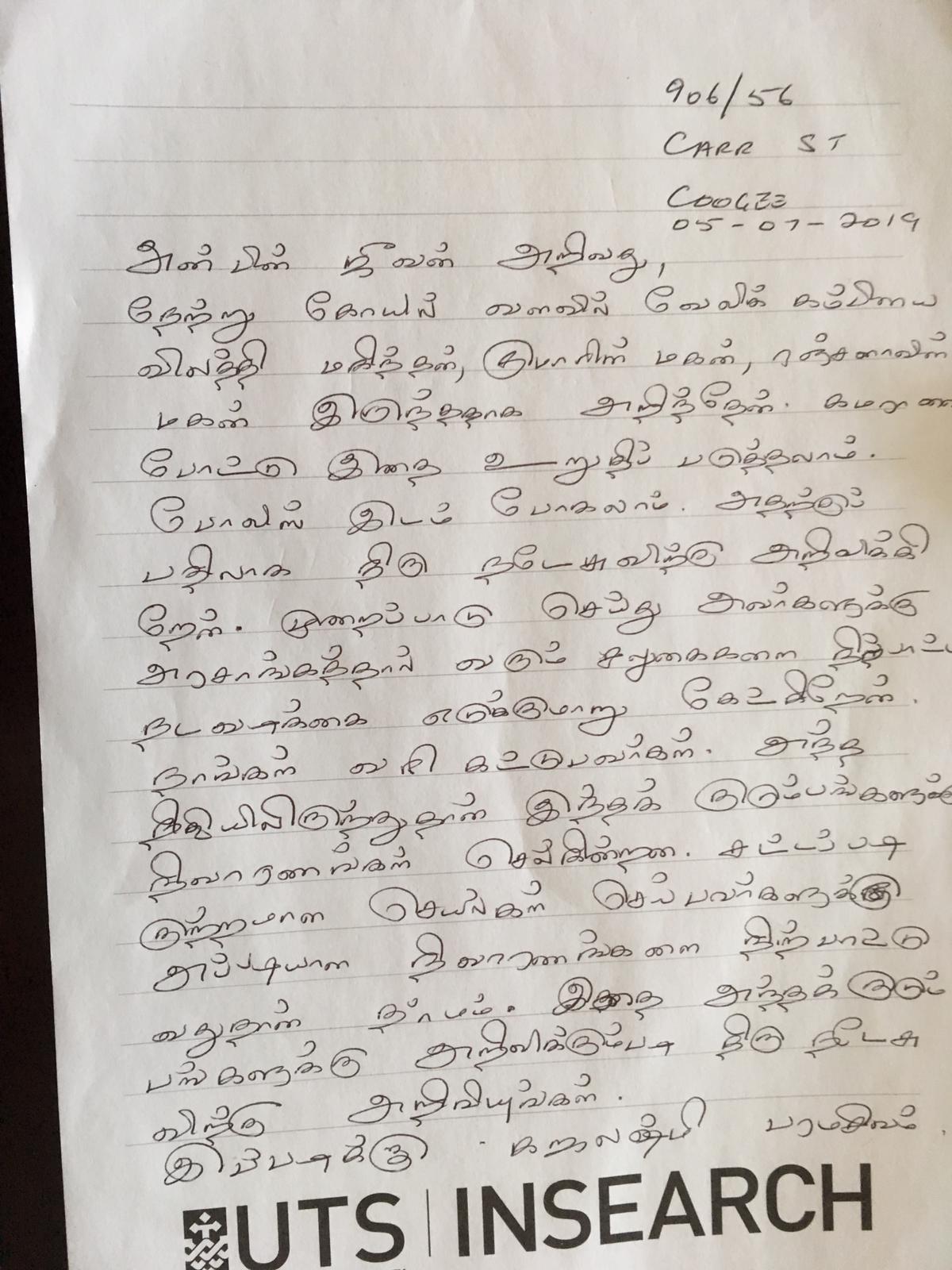
As Indian Finance Minister stated – the government owes the honest tax payer. It so happened that I wrote as follows to a community leader in Thunaivi – Vaddukoddai – on the same day the UTS – Insearch opened in Sri Lanka. I had this notepad from my channel partnership days with this institution.

The note is a complaint against three youths who loitered in temple area as if it were ‘public’ property. I have suggested that their family welfare handouts  be curtailed because we the victims are ‘tax-payers’. The person to whom I wrote has full knowledge of my investment in education in that area and that Australian Tamil Management Service under which we conduct training was linked to UTS-Insearch. To me this confirms the parallel of the Indian Minister’s elephant legend. My one is known as ‘The temple in our heart’ by Poosala Nayanar.  
The folks of Thunaivi are linked to institutions of higher education largely through others – including those like me who demonstrate capability to find intellectual solutions as opposed to physical actions and reactions.

The Indian Finance Minister connected the Parliamentarians to the essence of Tamil contribution to good governance inherited from our ancestors. I did likewise connect Vaddukoddai folks to my belief in global education. It was no coincidence that the two happened on the same day. Our individual and private investments in higher education is now pooled by institutions such as UTS-Insearch to balance the global equation in relation to investment in higher education and their returns. When every emigrant of Lankan origin does that – Sri Lanka would become global and the Sinhala only communities would be more isolated than they are now. They would also generate their parallels – such as Tamils only and Muslims only communities which would become their natural opposition in democracy. If those communities are punished by those who claim to be democratic – and take such powers into their custody – the return would be eye for an eye by reactionaries and/or  punishment as per radical mind structure. Sri Lanka has had enough experience of such separatism with government support.  Repetition would result in more export of Sri Lankans for economic purposes – the very reason why government promotes local culture through politics without belief.

If Buddhist leaders had acted out of belief – they would have shown the connection between Buddha’s teachings and their current structures. As per  Gnansara Thero’s call all Buddhists are Indians because Buddha was Indian. The wise raise ownership to higher common levels so that all investors would reap reliable returns.

Monday, 8 July 2019


Gajalakshmi Paramasivam

08 July  2019

Buddhist Isolation?

Even if you are a minority of one, the Truth is the Truth.” – so said Mahatma Gandhi. When we live in truth natural forces unite us with others who also live by their truth. The forms may be different but the experience is One. True experience when shared empowers exponentially. That is the value of Governance. As per Al Jazeera report headed ‘Sri Lanka on alert as Buddhist monks meet over presidential vote’:
[Police lined up on the streets of the Sri Lankan highland city of Kandy and the army was on standby, as hardline Buddhist monks gathered for their first big assembly since a spate of deadly bombings targeting churches and hotels on Easter Sunday.
Galagoda Aththe Gnanasara, the influential head of the Buddhist nationalist group Bodu Bala Sena (BBS), has called for as many as 10,000 clergymen from across the country to attend the meeting on Sunday.]
Unless Buddhists feel they contributed to this problem – they do not have democratic rights to participate in the solution. The problem Easter problem was apparently between Muslims and Christians at the cultural level. Neither group has sought the involvement of Buddhists as successful practitioners of their own order. The constitutional provisions have also separated Buddhists from non-Buddhists.  The Easter problem confirms this separation which has also been given form by government as being between Muslims and Christians. Both groups being part of minority  will manifest their own habits in a ‘free and natural’ environment. The government strongly influenced by Buddhist monks are foreigners to these minority groups.
As per the above report Buddhist monk Gnanasara is reported to have stated:
["Today, the Sinhala ethnicity, which has developed this country historically, has become very weak ... There is no leader who holds responsibility for Sinhalese". 
"We will only turn back after creating a leader to the country and getting the power to Sinhalese. Trust us" ]
The above is denial of  ownership by non-Sinhalese. But as per Gandhi’s discovery – even One person can have her/ his nation within the country called Sri Lanka. That is what prescriptive rights are about. The land through which that person realises such nationhood is hers/his by belief. As per the law of prescription – possession needs to be adverse, overt  and uninterrupted. In other words, these confirm belief based ownership. This is possible where the lawful owners neglect the property / position. Likewise when the lawfully elected government  neglects parts of the country – and an individual or group develops self-governance, such ownership becomes more valid than the ownership by law. When it happens through religion – then that governance is more valid than government by letter of law.
A citizen who practices the law more than the government  at a particular area – is entitled to use the government as a ‘facility’. Hence the ‘user pays’ system.
I believe that the Police facilities in Vaddukoddai area are such facilities in my case. When the minds of officers merge with such self-governing persons – their level of ownership is also escalated. Likewise when the government accepts such personal development of nationhood – the standard of government is elevated. But where there is law on the side of one group – such as Buddhist monks in this instance – and believe on the side of the other – the latter has the responsibility to demonstrate adverse possession – i.e. – opposite pathway to the lawfully endorsed Buddhist group. True rebellion happens through such adverse possession of the citizens’ pathway.
In Sri Lanka – politics is strongly linked to religion instead of land. To be also democratic there needs to be clear separation of powers between religious groups. The Easter bombings are the concerns of Muslims and Christians and not Buddhists who officially isolated themselves in 1972 through Buddhism Foremost provision in the Constitution. Any breach of the constitution that hurts a believer – albeit through a different pathway – would bring about exponential damage to the official government. Greater official empowerment of a Buddhist leader would only strengthen this return karma. I have witnessed this here in Australia, through my own belief based actions which returned exponentially when I was separated from the main group. The success of immigration  is strongly linked to Equal Opportunity to prevent such exponential adverse returns through the system of Truth.
Buddhists as Opposition of other religions have the duty to complete their ‘packaging’ and find leaders of ‘Buddhists Only’. They lack jurisdiction over non-Buddhists. The alternate is to join at Process level – as stipulated by the law. Then the Common Law elects the leader who would have jurisdiction over all citizens.

Sunday, 7 July 2019


Gajalakshmi Paramasivam

07 July  2019

Australian Sinhalese or Global Sinhalese?
When politicians speak, we need to take only that which we identify with. That is when we actually vote for self-governance in a free environment.  Likewise, politicians also need to listen to our true experiences as our Equals. Then we would not cheat each other and thereby cheat ourselves.
Last night we celebrated the family life of our friends Gowri & Paramaguru here in Sydney. I was so very happy to be with the Engineering group that has become like family. As Ramachandran said when I mentioned that we were related through the marriage of his daughter to a relative of mine – ‘we were already family’ through the Engineering group. This meant that one’s achievements and challenges felt like ours. That is commonness that I felt deeply in that environment.
This morning I received expression of deep appreciation from a Sri Lankan of Sinhalese origin, for my article headed ‘Did we actually vote for or against Death Penalty?’ In  contrast  I noted the use of separatism terminology - ‘Sinhalese’ by Minister Patali Champika Ranawaka in the report headed ‘Sri Lanka could have a dearth of intellectuals in another 10 years – Patali’:
[Stating that the second largest urban Sinhalese population is reported from Melbourne in Australia, the minister said the local youth is keen on leaving the country.]
This means that the minister is seeking the votes for Separatism. As per Wikipedia report:
[In 2008 Ranawaka called the Muslim community in Sri Lanka 'outsiders' sparking widespread protests]
The Minister himself is reported to be an Engineer. Wikipedia reports as follows as to how this Minister as a student used the education facility for political purposes:
[Ranawaka was active in politics while in university in the late 1980s as a member of the pro-JVP student union having spent over eight years as an undergrad in the university engaged in politics. He was arrested as part of the crackdown student activists during the JVP Insurrection in 1988 and again in 1991He formed the Non-political organization called, 'Janatha Mithuro' with some of his colleagues like Ven.Athuraliye Rathana Thero, Nishantha Warnasinghe and Malinda Seneviratne. 'Janatha Mithuro' was criticized for its right-wing anti-Tamil ideology and actions.]
The above in extreme degree translates as militancy and terrorism.
The following comments explain the Minister’s own thinking order:
[The country must move forward in practicality regardless of the philosophies it follows, says Minister Patali Champika Ranawaka.
Addressing a public meeting held in Avissawella last evening (04), he said education can change the direction of a country.
What is important to move a country forward is not its philosophies but the practical aspects, the minister commented.]
In other words – the Minister is placing a ceiling on the height of our thinking as professionals. His separatism root was in University which was demoted by him to ‘practical’ level in an environment where he was more ‘free’ than his parallel in a more multicultural university in Melbourne.
Our deep motives / purposes always deliver returns. The average thinkers ‘see’ largely the manifested outcomes. The more educated thinker identifies with the return in her/his mind. The more of our investment we manifest for immediate benefits – votes in this instance, the less we have for higher thinking – to be shared mind to mind.
Since Universities in Sri Lanka are funded by the government – the exodus of graduates is a loss of that the next generation Sri Lankans suffer. I see it all the time in Jaffna  where there is a gap due to this exodus. A good proportion of the ‘Sinhalese’ community in Melbourne would not develop their heirs in Sri Lanka but use Sri Lanka largely for leisure and relaxation purposes. When our Engineering family member Ramachandran said in this regard ‘We all talk but you actually do’ . To me that is the ‘practical angle that must prevail’ to keep the continuity of education and its higher values for Sri Lankans.

This morning we went over to Bronte to collect Lego pieces – paying $70. I do not recall buying such toys for our own children. But the motivation comes now from those parents who do not want their children to be second to their ‘foreign’ counterparts. Even the young mother in our opportunity shop ‘assembles’ and sends me photos. Since Lego is educational and the lady is interested – her joy becomes my motivation to which my husband also contributes.  Oneness through  feelings becomes the soul power that motivates us. It is a small way in which we replace ourselves with ongoing shared energies. One who needs to ‘see’ to believe would lack this soul connection. The practical type that the Minister mentions is of this ‘seen’ category. The more philosophical we are the higher our thoughts are confirmed to be. The higher the thoughts the wider the coverage to include others in our ‘home-group ’. It’s only Sinhalese in the case of Minister Ranawaka.
 Those who vote for Mr Ranawaka would be voting for Separation and hence would be in breach of Article 157A (1) of the Constitution which states:

[157A. (1) No person shall, directly or indirectly, in or outside Sri Lanka, support, espouse, promote, finance, encourage or advocate the establishment of a separate State within the territory of Sri Lanka]

To recognize a group as Sinhalese when there is Equal Opportunity to recognize ‘Sri Lankans’ is in breach of the above provision which was given form due to Vaddukoddai Resolution 1976.  The Tamil resolution also recognized a separate Tamil state which was the parallel of Minister Ranawaka’s Sinhalese state. When JVP fought against the government – in 1971 it was separating the Sinhalese community into alleged higher thinkers using philosophy of  governance and alleged practitioners using manifested outcomes to measure success. Often Public Service moves towards Business-Unit structure when the latter becomes more powerful than the former. Sri Lanka claiming to be a Sovereign nation – needs to manifest the Equal and Opposite of every such true independent manifestation. Vaddukoddai Resolution maintained this balance at philosophical level – even though JVP manifested the rights of Sinhalese at the ‘seen’ level. It was LTTE that balanced the JVP manifestation   to ‘show’ Equality which is an essential criterion in determining ‘sovereignty’. The LTTE however, went beyond the level need to balance the JVP manifestation and now the likes of Minister Ranawaka are trying to balance that  and are likely to go beyond the limit to generate another opportunity to young Tamils to continue with this cycle of separatism.
Sinhalese and Tamils in Australia have largely lived in separation from each other. To the extent they go beyond the need to ‘show’ Sri Lanka as a sovereign nation – such separation becomes dividing factor. In contrast – Minister for Home Affairs – the Hon Vajira Abeyawardene , who is also an engineer demonstrated commonness with us when we met him accidentally in Jaffna early this year. I believe that we manifested ‘commonness’ through that unplanned and natural communication – as equals until known otherwise.

The Sinhalese in Melbourne confirm multiculturalism in Australia and not in Sri Lanka. Once we migrate our horoscopes are written to show our Sri Lankan debits and credits as sins and virtues respectively. To be of value to Sri Lanka – we need to demonstrate global values – either manifested showing global form or through higher thinking – including philosophical thinking in common areas. We know the oneness once we feel the other’s joy as ours and other’s pain as hours. When we relate as seniors-juniors  in an unstructured environment we go backwards. But many emigrants returning to ‘Sri Lanka’ tend to do just that.

As per the philosophy of dual citizenship – a person becomes incapable of giving two forms to a home-nation at the same time. It can be regional which includes two countries – or global which extends beyond the immediate physical connections. If that globalization happens through Tamil culture – then we become Global Tamils of Sri Lankan origin. Likewise if it happens through Sinhalese culture – then we become global Sinhalese of Sri Lankan origin. Some may be limited to being Australian Sinhalese / Tamils. But they cannot be Australians and Sri Lankans at the same time.
By using Mr Ranawaka’s thought order – Australian Sinhalese cannot be merely added to Sri Lankan Sinhalese to make up a group that would add to the autonomy of Sri Lanka. It merely causes imbalance to the claim of sovereignty of Sri Lanka.


Saturday, 6 July 2019


Gajalakshmi Paramasivam

06 July  2019

Did we actually vote for or against Death Penalty?

In democracy the voter is ultimately responsible for the actions of the Government. When Mr Sirisena was elected President in 2015, we claimed that Tamils were the marginal group that made this possible. Hence Tamils have now the responsibility to blame themselves for the Capital Punishment by the current President.
Al Jazeera reports as follows in relation to the declarations by Mr Sumanthiran who represents Tamils in National Parliament:
[MA Sumanthiran, a Sri Lankan legislator and a lawyer representing a condemned prisoner, said death by hanging was a "cruel and degrading punishment".
"It is the fundamental right of any individual not to be subjected to cruel and degrading treatment," said Sumanthiran. "It is on that basis we want courts to hold that execution of capital punishment is a violation of the Constitution."]
What measures has Mr Sumanthiran taken to discipline his electorate in regards to the development habits that would ultimately become punishable in this manner? Is it not his responsibility to discipline such voters – so they would not become punishable?
Yesterday for example, I complained to the local government member for Thunaivi – Mr Arumugam Nadesu – about a group of youth who bend the fence wires and come into the temple grounds to chat. I suggested that their family welfare handouts be stopped because the tax-payer who provides such funding is being disrespected. Mr Nadesu may not have the knowledge to implement this but he knows that the complaint is valid and he has enough influence in that village to quietly discipline them. That is the value of democratic representation.

The essence of this has been bought out by Mr M S M Ayub through his articleWho is genuinely against capital punishment?’ – published by Daily Mirror

Mr Ayub presents his thinking as follows:
[There are political party leaders and leaders of non-governmental organizations (NGOs) among those agitated by the announcement. Are all these voices against the implementation of the death sentence honest?   
In a close scrutiny of the history of most of these political parties and NGOs one would get a negative answer to this question. They might have always expressed their opposition against the re-implementation of the capital punishment that was carried out last in 1976 in the country. But almost all of them, at some point of time in the history, have carried out or justified extra-judicial killings of their opponents or those who held views opposed to theirs.]

In essence, only those who worked to actively oppose such outcomes  and/or  those who as part of the group disciplined them internally through everyday life – have the power to defeat such punishment by the authorities – be it the Executive or the Judiciary.
Mr Ayub highlights as follows:
[The country for the first time in the history saw dead bodies floating in rivers and burning on what were later called the “tyre pyres” during the first insurrection of the Janatha Vimukthi Peramuna (JVP) in 1971. It was said that over 20,000 suspected insurgents, most of whom were believed to be innocent youth had been killed in this manner during that insurgency. 
These bodies on tyre pyres and in rivers were not of those killed in fighting or crossfire between the armed forces and the insurgents, rather they had been killed after being captured.
Never a member of any of the then ruling parties - Sri Lanka Freedom Party (SLFP), Lanka Sama Samaja Party (LSSP) and Communist Party of Sri Lanka (CPSL) had regretted those killings. They were not only extra-judicial killings but also committed as a method of capital punishment for the victims’ alleged involvement in the insurgency or sometimes for the mere moral support for it.  
President J.R. Jayewardene set December 31, 1979 as a deadline for the then Security Forces Commander, Jaffna,  T.I.Weeratunga to eliminate the Tamil rebels, especially the Liberation Tigers of Tamil Eelam (LTTE). Brigadier Weeratunga failed to fulfill his assignment, but the people of Jaffna saw for the first time mutilated human bodies floating in the Jaffna lagoon during his assignment.   
]

As per my experience, where the law and custodians of its power fail, the truth prevails. Tamils who failed to question the LTTE’s own killings lost their right to question the capital punishment meted out to them. Only those who internally disciplined them for such killings or mentally separated themselves from the ‘wins’ shown by the LTTE have the authority to question the government’s parallel at national level. Even now, there is very little public recognition for my work amongst the Tamil Diaspora due to this ‘internal discipline’ and from time to time punishment through express opposition to militants’ outcomes that have become public. From time to time, someone does privately express deep appreciation for my work – as happened this time also in Jaffna.
Most of the time, I believe in the support I get from those whose work I genuinely value and uphold through my own work. I may not know any of them personally but when I uphold the laws that we inherited from them – I become their medium for current manifestations. This in effect overrides the time based separations of power. The parallel of that in democracy is the merger of my work with those who demonstrate similar depth in the issue – as Mr Ayub has demonstrated through his above mentioned article.  Being recognized purely through current members is democratic politics. This overrides the place based separation of power. In both there is a component of Natural powers even if we do not recognize them.
The Judiciary that uses with due respect - laws developed by others before in that nation – is naturally supported by those ancestral powers. Judiciary that uses with due respect  - laws developed by those living in other nations are naturally supported by  global powers.
As per current reports – the current Opposition Leadership in National Parliament has expressed opposition to the death penalty. But is that based on their own past? I identify with the following conclusion in this regard:
[The allegations of extra-judicial killings and disappearances of civilians against the Mahinda Rajapaksa regime landed the country in an UNHRC mess. The famous white vans was a phenomenon that belonged to the Rajapaksa regime. The Presidential commission (Maxwell Paranagama Commission) appointed by President Rajapaksa to investigate into the allegations of  “disappearances” had received more than 19,000 complaints. Except for a few cases, the term “disappearance” seems to stand for killing after abduction.  
There is no doubt that almost all these extra-judicial killings were a method of capital punishment carried out for expressing views or acting against the incumbent government, despite a relatively small number of death sentences delivered by courts being under a moratorium, falsely signifying the sympathy and respect of the leaders of the government for human lives. 
]

I raise the question also in relation to Tamils who remain/ed silent about LTTE’s extra-judicial killings. If we are part of a community and we remain silent including mentally  when the leaders  act unjustly – then in the Court of Natural Justice, we lose our right to vote. When we are deterred from expressing our feelings due to fear of physical injury and/or death – we need to more strongly mentally oppose such wrongs to protect our right to vote in the Court of Natural Justice.
Our true votes are as per our conscience. If we are not able to express our vote due to fear of losing status – then we lose the right to criticize other community leaders. Right or wrong – the community that we claim to be part of is credited or debited with our rights and wrongs. If  an act that is claimed to be wrong by others was unavoidable by us – then we need to refrain from finding fault with others for the same wrong.

I do not know the details of the following report but I identify with the common value – of ‘an eye for an eye’ syndrome practiced by militants and those with little knowledge of law. This is highlighted by Mr Ayub as follows:

[There is no gainsaying about the brutality of the southern or northern rebels either. The pinnacle of the JVP /DJV cruelty might be the butchering of the entire family including elderly women and children of the then DIG Southern Range Premadasa Udugampola in 1988. Two years before, in 1986, the LTTE had excelled all other armed groups in the country by cold-bloodedly murdering more than 400 members of the Tamil Eelam Liberation Organisation (TELO) including its leader Sri Sabarathnam, not in clashes but for not falling in line with them. More than 600 policemen who had surrendered to the LTTE in June 1990 were eliminated allegedly under the orders of the then Eastern commander of the outfit, Vinayagamoorthy Muralitharan alias Karuna]

The question is – if South was under JVP rule and North under LTTE rule – would their genuine vote be to oppose  the Death Penalty by a democratic government or would it be to endorse it?
Mr Rajapaksa’s would have been to endorse it and likewise his junior in that regime – Mr Sirisena’s. Likewise – if  LTTE leader were alive today – his true vote would have been to endorse it and likewise his current junior that Mr Wigneswaran has become. Anyone who ‘takes’ the benefit produced by someone else becomes their beneficiary / junior.

The death penalty is deserved by majority Sri Lankans who are heirs of those who remained quiet even in their private quarters – when such death sentences were being carried out by the custodians of power. This includes journalists who failed to express support to Lasantha who was also given the death sentence. We do not see many Sri Lankans protesting against that in Sri Lanka today.
So one is entitled to conclude that majority Sri Lankans accept death penalty by their home-group and therefore by the government that represents such home-groups.


Friday, 5 July 2019


Gajalakshmi Paramasivam

05 July  2019

Tourism Ownership
[While the figure is accurate, what the report failed to say is that the number of foreign tourists to Sri Lanka last month — 63,072 — is a 66 percent increase compared with the 37,802 visitors which the country received in May, which indicates it is on the mend.] Skift Article ‘What the Western Media Gets Wrong About Sri Lanka Tourism’
I was one of those who confirmed confidence in Sri Lanka through my visit in June. I rely on my own intuition about such issues. When a close relative asked me whether it was safe – my response was ‘need before safety’. The primary reason was the land matter in Colombo which was adjourned by the judge. Disappointed though I was – that was my reality. By now I have learnt to rely on my genuine contribution, do my best through due processes  and leave the rest to the Lord. I did likewise, when visiting Jaffna where I was able to boost the confidence of many workers including in the tourism industry but more importantly I was able to save a particular family that was on the verge of giving up on life itself.
As per the above article:
[ All of us are doing well and working hard to rebuild our industry which took a whack as we all know,” Hiran Cooray, chairman of Jetwing Symphony, told Skift.
Forward bookings for July and August for his Jetwing Hotels gives Cooray a reason to be cheerful.]
When I read the above, I thought of the Taxi Driver Vinod whose face beamed when he saw a coach at the entrance of Jetwing Jaffna. Vinod said ‘they have started coming again’. The ‘they’ included those from Southern Sri Lanka also. I confirmed that I also had already booked to come again soon. Such natural boost helps them project their own business income. It confirmed also – the narrowing of the ‘gap’ between Northerners and Southerners.
Jetwing is one of those institutions that has shared its ‘Commonness’ with Northern Sri Lanka by facilitating diversity to confirm the local culture – and at the same time promoted standard practices of global standards that one finds usually in Colombo private sector. In Colombo I spent time in such environments to invoke my feelings of ownership. In a strange way it felt that I was going back to my days of articleship at M/s Satchithananda Schokman Wijeyeratne & Co – Chartered Accountants. Back then I had to watch my budget but now I have to watch my health. In terms of economy the way the media compared  with past – mine was exponential progress. That is historic cost method.  Using Current cost method – I felt as comfortable in Colombo as I do in Coogee; NSW; Australia. I felt blessed when the staff at Galadari allocated room 906 to me. The significance of it is explained as follows:
[I asked the reception guy at Galadari Hotel in Colombo whether they had made a calculated decision to allocate room 906 to me? The young guy looked perplexed and said it was one of their better rooms! I explained to him that to me it was important to know because it was our home-unit number in Coogee; NSW. I felt blessed in terms of the feelings I had. The room is exceptionally good. More importantly, I felt that the hospitality industry was saying ‘thank you’ genuinely. I felt for the industry when it was badly hurt. Hence it felt as if I was being treated as family.
This is the second time I am staying at Galadari. The first time was in 2004 when I also was invited to participate in the 25th year anniversary celebrations of Airlanka / Sri Lankan Airlines. During the celebrations I protested against lack of appreciation for the pioneers who were not present. To me they, as my ancestors were part of me. I continue to attribute to them and keep them also  in mind whenever I make contributions to the National Carrier.] article of 24 June headed - SRI LANKA NEEDS A BELIEVER – at http://austms.blogspot.com/2019/06/

To some this may seem like coincidence. But to me it was confirmation that my contribution over the years – to Tourism in Sri Lanka – including through the global standards I practice facilitate tourism at exponential rates of return. That is the deep value of ownership. Every member of the Sri Lankan Diaspora who attributes to the land through such feeling will likewise say ‘thank you’ through coming back to that land and living there at global standards. Showing others through demands to change policy is truly secondary to this. Gandhi confirmed that by following the law and  truth – even when he lived as part of the masses. We have to become that group to identify with its needs. This can be as a customer or supplier.
Sri Lankans are by now conditioned to bomb attacks. If they are able to go about their daily life – that would be the best way to invoke tourists. Most Western nations including Australia and New Zealand now consider bombings as part of regular risk in daily life. They would not be put off for long by such attacks. I know I was not. That confirms that I am Sri Lankan and not foreigner.


Thursday, 4 July 2019


Gajalakshmi Paramasivam

04 July  2019


The Death Penalty  & Democracy
[At yesterday's Cabinet meeting, President Maithripala Sirisena reaffirmed his position to implement the death penalty but said final decision would however, depend on the Supreme Court ruling on the FR applications filed against his move.] Daily Mirror article ‘Prez determined to implement death penalty’
If the Supreme Court did rule against the Death Penalty that would further disqualify Mr Sirisena for the position of Executive President. In Court  - the two sides are Equal and Opposite. In Executive Administration the two sides are Senior and Junior. The law is the same. If a citizen therefore is more right than the President – then that law that so rules is a foreign law OR the President as an Executive has failed to use that law. One is entitled to use belief which carries absolute power. But expressing that the final decision would depend on Supreme Court ruling Mr Sirisena  has confirmed that his decision was not based on that absolute power. If it was – Mr Sirisena would feel that he was the one facing the death penalty.
As I say often – ‘Mothers are feelers and Fathers are thinkers’. The elected representative is the Mother and the Executive is the father who connects the family to wider world. True mothers are known as Shakthi (Energy) in Hinduism due to their ability to work the system through the seen members. Being One / Sovereign is Mother power. Showing that structure so outsiders could relate to the family - is father power. Mr Sirisena who is playing the role of father – in this instance – is confirming dependence on the Supreme court and therefore that the Supreme Court is the Executive government. He has thus confirmed lack of independence in applying the law as Executive in charge of the whole.
Tamil King Ellalan who is reported to have ruled Sri Lanka from 205 BCE to 161 BCE did is a good ancestor from whom every elected representative of Sri Lanka has the opportunity to inherit common governance power. This King felt the pain of mother cow as his own:
[Ellalan received the title "Manu Needhi Cholan" (the Chola who follows Laws of Manu) because he executed his own son to provide justice to a cow. Legend has it that the king hung a giant bell in front of his courtroom for anyone needing justice to ring. One day, he came out on hearing the ringing of the bell by a cow. Upon enquiry, he found that the calf of that cow had been killed under the wheels of his son's chariot. In order to provide justice to the cow, Ellalan killed his own son, Veedhividangan, under the chariot as his own punishment i.e. Ellalan made himself suffer as much as the cow. Impressed by the justice of the king, Lord Shiva blessed him and brought back the calf and his son alive. He has been mentioned in the Silappatikaram and Periya Puranam. His name has since then been used as a metaphor for fairness and justice in Tamil literature. His capital was Thiruvarur.
The Mahavamsa also states that when he was riding his cart he accidentally hit a Chetiya. After that he ordered his ministers to kill him but the ministers replied that Buddha would not approve such an act. The king asked what he should do to rectify the damage and they said that repairing the structure would be enough which is what he did.]
Between Tamil king Ellalan and Sinhalese President Sirisena – it was the Tamil who planted the seeds of Democracy in Sri Lanka at a much deeper level than the current ruler. Every Sri Lankan is entitled to that heritage and it would be hers/his if it is not blocked for whatever reason. On the part of voters – those who vote for Mr Sirisena after this – confirm that they do not believe in democracy and therefore their own power to govern. It started with them and now that karma is returning to them.
 It is indeed a shame that this is being highlighted on 4th  of July. But the Truth is the Truth and It manifests Itself at the time of need. 


Wednesday, 3 July 2019


Gajalakshmi Paramasivam

03 July  2019


Sri Lanka has become International due to Easter Bombings?
[On Monday, the attorney general’s department said in a letter to acting police chief CD Wickremaratne that it had ordered Fernando and Jayasundara to be named as suspects and produced before a court because a presidential commission of inquiry found grounds to charge them with dereliction of duties and criminal negligence.
The letter said crimes the officials were suspected of having committed fall within “grave crimes against humanity” under international law.] Associated Press report headed ‘Sri Lanka bombings: police and defence chiefs held on negligence charge’
Tamils whose loved ones were killed in the ethnic war are awaiting the very UN declaration that the current Attorney General has made against these two officers. UN is duty-bound to use International law. Not so the above mentioned officers – Fernando and Jayasundara.
If indeed these officers are being charged under international law – why were their parallels not charged under the same law for negligence  that resulted in crimes being committed against Tamils during the 30 year ethnic war? Is it all a drama to fool the public?
The following is relevant in identifying with the mind-order that produced these outcomes:
[Fernando told the committee Sirisena was not easily accessible for discussions. Jayasundara said Sirisena asked him after the blasts to take responsibility and resign and said he would be cleared in any subsequent inquiry.
Jayasundara also said Sirisena had asked him not to attend national security council meetings since last October, when Sirisena fired the prime minister, Ranil Wickremesinghe, in a power struggle that triggered a seven-week political crisis.
Wickremesinghe was subsequently reinstated by the supreme court.]
In other words, as per the above one is entitled to conclude that the Easter Bombings happened due to the disconnection in the flow of Due Processes that the government was duty-bound to follow. Instead of explaining himself to the foreign diplomats – should Mr Wickremesinghe  not be taking legal action against the President – stating the Attorney General as the Respondent? This has been provided for in the Constitution through article 35(1):
[35. (1) While any person holds office as President of the Republic of Sri Lanka, no civil or criminal proceedings shall be instituted or continued against the President in respect of anything done or omitted to be done by the President, either in his official or private capacity: Provided that nothing in this paragraph shall be read and construed as restricting the right of any person to make an application under Article 126 against the Attorney-General, in respect of anything done or omitted to be done by the President, in his official capacity: Provided further that the Supreme Court shall have no jurisdiction to pronounce upon the exercise of the powers of the President under Article 33(2)(g).]
[126. (1) The Supreme Court shall have sole and exclusive jurisdiction to hear and determine any question relating to the infringement or imminent infringement by executive or administrative action of any fundamental right or language right declared and recognized by Chapter III or Chapter IV.]
Why did Mr Wickremesinghe not take action through the very process that reinstated him as Prime Minister? Was that negligence a confirmation of ingratitude to the Judicial process? The best way to say ‘thank you’ while we are active in a position is by doing our duty through the very process that protected our rights and thereby facilitated us to be active in that position. Beyond law we are always protected by truth. Practice of law through legal action strengthens our Administrative processes – especially in relation to those who are outsiders to us. The outcomes delivered ought to be secondary to this deeper value of common mind-order.
The October 2018 political crisis confirmed to the People that the judicial process in Sri Lanka was more reliable than the political process. Why did Mr Wickremesinghe not activate this process and invoke the blessings of our judicial ancestors? Article 14A of the Constitution covers the right to ‘intelligence’ as follows:
[14A. (1) Every citizen shall have the right of access to any information as provided for by law, being information that is required for the exercise or protection of a citizen’s right held by:-
(a) the State, a Ministry or any Government Department or any statutory body established or created by or under any law;
(b) any Ministry of a Minster of the Board of Ministers of a Province or any Department or any statutory body established or created by a statute of a Provincial Council;
(c) any local authority; and
(d) any other person, who is in possession of such information relating to any institution referred to in sub-paragraphs (a) (b) or (c) of this paragraph.]
The intelligence/information  that the President has gained is the property of  Common Sri Lankan. To the extent the Prime Minister needed to access it to protect that Common Sri Lankan’s right to manifest her/his religion,  he had the duty to take action against the President by stating  the Attorney General as respondent. Article 14(1) (e ) is of particular significance in the case of Easter bombings:
14. (1) Every citizen is entitled to – (e ) the freedom, either by himself or in association with others, and either in public or in private, to manifest his religion or belief in worship, observance, practice and teaching;
We are often discouraged from activating such judicial processes in an unreliable system. But to the extent we are genuine – it regulates our minds and helps us to find completion in areas where we are queens or  kings as well as citizens.
The ruler’s work is incomplete until there is an heir. The heir happens naturally  when the ruler and the citizen become one. The further away that heir is physically – the wider the coverage and hence confirmation that the experience tends towards being global.